From Minimalism to Asceticism After 60
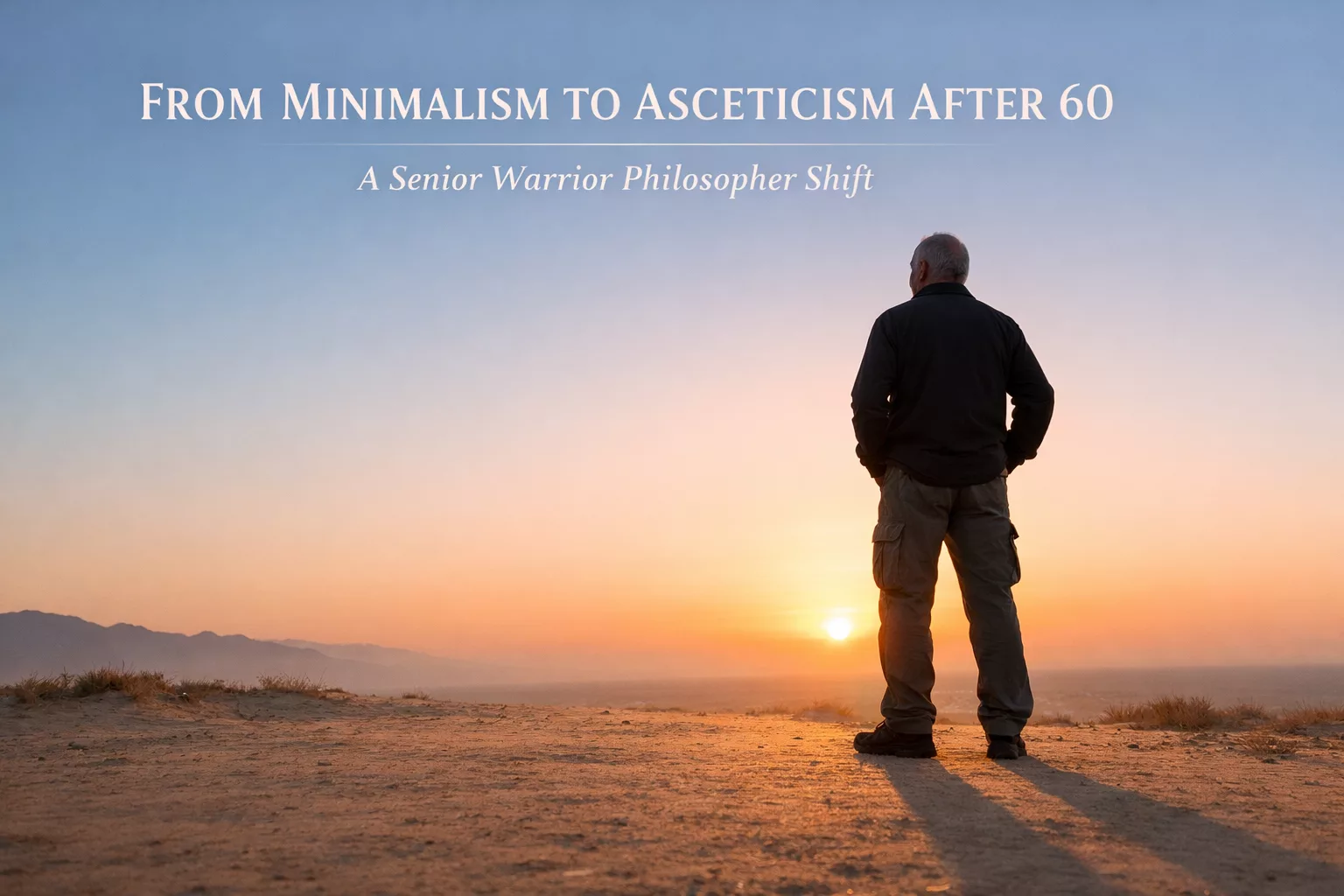
From Minimalism to Asceticism After 60
A Senior Warrior Philosopher Reflection
Minimalism helped many of us declutter our homes.
Asceticism helps us declutter our impulses.
There is a difference.
Minimalism says:
“Own less.”
Asceticism says:
“Need less.”
At our age, that shift matters.
Why Minimalism Is Not Enough
Minimalism is a good starting point.
It clears space.
It lowers expenses.
It reduces noise.
But it can become comfortable.
You can own fewer things and still:
- Overeat
- Over-scroll
- Overreact
- Overspend
- Over-medicate your boredom
Minimalism simplifies your surroundings.
Asceticism strengthens your will.
And after 60, strength of will is more important than stylish simplicity.
What Asceticism Really Means
When people hear the word asceticism, they picture:
- Cold caves
- Extreme fasting
- Self-punishment
- Giving up everything
That is not what we are talking about.
True asceticism is controlled restraint.
It is the deliberate choice to say:
“I do not need this.”
It is training the mind and body to operate with less — not because you are forced to, but because you choose to.
For a Senior Warrior Philosopher, asceticism is:
- Eating with discipline
- Spending with intention
- Speaking less, listening more
- Training the body consistently
- Reducing emotional drama
It is strength through reduction.
Is Asceticism Practical at 70?
Yes — if it is intelligent.
No — if it is extreme.
You are not 25.
You do not recover like you once did.
You likely manage medications, glucose, blood pressure, balance.
So asceticism at our age must be strategic.
It should improve:
- Stability
- Blood sugar control
- Mental clarity
- Financial margin
- Emotional calm
It should not:
- Risk falls
- Trigger weakness
- Cause dehydration
- Create social isolation
- Lead to reckless fasting
The warrior trains hard.
The philosopher trains wisely.
Why Seniors Need Ascetic Discipline
The modern world is not designed for restraint.
It is built for:
- Convenience
- Comfort
- Consumption
- Stimulation
Especially for retirees.
We are told:
- “You deserve to relax.”
- “Take it easy.”
- “Indulge yourself.”
Relaxation is not the same as decay.
Without discipline, the body softens.
Without structure, the mind wanders.
Without limits, spending expands.
Asceticism is a guardrail.
It keeps the second half of life from drifting.
The Physical Case for Asceticism
For seniors, controlled restraint can improve:
- Insulin sensitivity
- Weight stability
- Joint load
- Sleep quality
- Balance
Simple practices:
- Stop eating after dinner
- Walk daily, no excuses
- Lift light weights consistently
- Remove one processed food
- Reduce sugar to near zero
You are already working on disciplined nutrition.
Asceticism sharpens it.
It means eating for strength, not pleasure.
It means hydration over soda.
Protein over pastry.
Movement over television.
Not extreme.
Consistent.
The Financial Case for Asceticism
Many seniors live on fixed income.
Asceticism creates breathing room.
It looks like:
- Canceling unused subscriptions
- Cooking at home
- Buying durable instead of flashy
- Delaying purchases 48 hours
- Avoiding lifestyle creep
Minimalism reduces clutter.
Asceticism reduces dependency.
It builds resilience.
If income drops or costs rise, the ascetic senior adapts.
No panic.
No drama.
No scrambling.
That is warrior composure.
The Mental Edge
Aging brings losses.
Energy shifts.
Friends pass.
Roles change.
Ascetic discipline gives structure in uncertain seasons.
Daily anchors:
- Wake at a consistent time
- Move the body
- Read something strengthening
- Limit news intake
- Practice one moment of quiet
Asceticism builds inner order.
When the world grows loud, your mind grows steady.
That steadiness is power.
The Danger of Going Too Far
You are not trying to disappear.
You are not trying to prove toughness.
Warning signs of unhealthy asceticism:
- Dizziness
- Social withdrawal
- Obsession with restriction
- Ignoring medical advice
- Feeling joyless
Asceticism should increase vitality, not drain it.
It should feel clean and sharp.
Not harsh and brittle.
A Practical Ascetic Framework for Seniors
Start small.
Choose one area.
Food
- Eat only at set times
- Remove one weak habit
Money
- Track spending weekly
- Cut one unnecessary expense
Body
- Walk daily
- Practice balance drills
Mind
- Limit digital noise
- Replace complaint with gratitude
One rule at a time.
Simplicity is power.
Minimalism vs. Asceticism
Minimalism asks:
“What can I remove from my space?”
Asceticism asks:
“What can I remove from myself?”
- Excess appetite
- Excess fear
- Excess distraction
- Excess spending
- Excess comfort
The Senior Warrior Philosopher is not trying to suffer.
He is trying to refine.
Is It Too Late to Begin?
No.
In fact, this may be the perfect time.
You have:
- Experience
- Perspective
- Fewer distractions
- A clearer sense of mortality
Asceticism becomes more natural when time feels precious.
You no longer want clutter — physical or mental.
You want precision.
The Phoenix72 Shift
Minimalism is stage one.
Asceticism is stage two.
Minimalism says: simplify your environment.
Asceticism says: strengthen your character.
After 60, comfort alone is not enough.
You want:
- Stability in your body
- Margin in your finances
- Calm in your spirit
- Discipline in your habits
Asceticism — practiced wisely — is not extreme.
It is controlled fire.
And fire, handled properly, purifies.
You are not shrinking your life.
You are sharpening it.
That is the path of the Senior Warrior Philosopher.
And it is absolutely possible — at 70, at 75, even at 80 — if it is done with restraint, wisdom, and steady effort.
Begin with one reduction.
Hold it.
Master it.
Then move to the next.
That is how strength is rebuilt in the second half of life.