Day 82/100 Grow Rich with AI in 2026
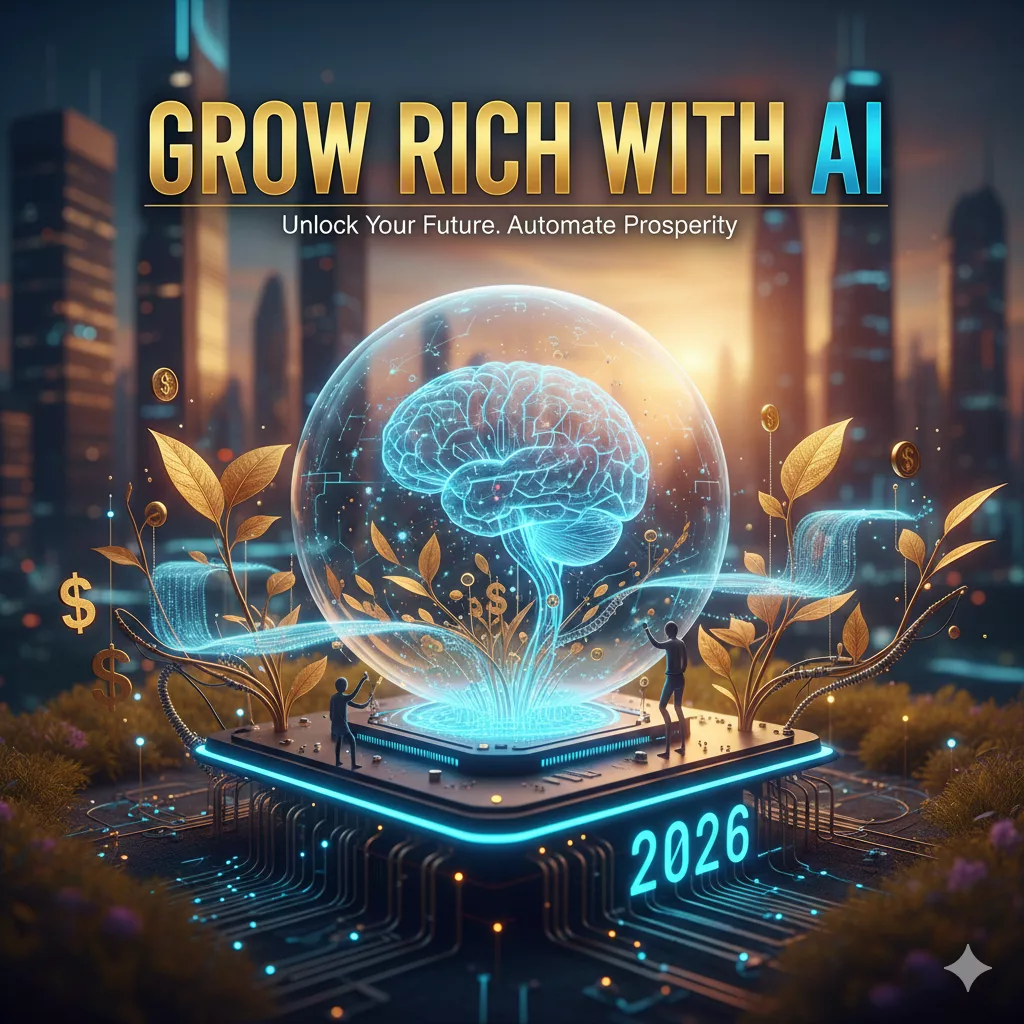
Grow Rich with AI in 2026
Stormin’
- Create an in-home base of core exercises.
- https://www.youtube.com/watch?v=weH1wL6y-Sc
=====
Introduction (book + market positioning)
Grow Rich with AI in 2026: How to Build Multiple Income Streams Using Artificial Intelligence, Automation, and Smart Tools by Aarav Malhotra is positioned as a beginner-friendly, non-technical “AI wealth” playbook aimed at people who want practical ways to monetize AI tools (ChatGPT, agents, no-code automation) through multiple income streams.
From the publicly visible product metadata, the print edition appears to be short (about 77 pages) and was published December 15, 2025 (at least on Amazon listings). (Amazon France)
Important limitation (so you can trust the critique): I couldn’t locate a reliable, accessible corpus of actual Amazon/Goodreads/B&N review text for this specific title in the open web results I can access right now (and Amazon pages often block automated viewing).
So the analysis below is a market-informed, comparable-title critique based on how readers historically respond to this category (make-money / passive income / “wealth with tools” guides), plus what your provided description signals—rather than a quote-level synthesis of verified reviews for this exact book.
1) Strengths (what sets it apart in its category)
Clear promise + strong “why now”
- Anchoring the book in “2026” creates urgency and freshness. In fast-moving tech, readers buy what feels current.
- The framing of AI as a “silent business partner” is a sticky mental model that sells well to non-technical audiences.
Beginner-first positioning (wide addressable audience)
- “No coding / no technical skills” expands the audience to:
- employees with fear-of-falling-behind,
- freelancers,
- creators,
- older beginners,
- side-hustle dabblers.
- The tone promise (“clear, conversational, human”) reduces intimidation—critical for AI newcomers.
Execution + mindset blend (a proven nonfiction combo)
- These books perform best when they balance:
- tactics (what to do),
- systems (how to repeat it),
- mindset (how to persist).
- The description explicitly claims this trio (“mindset shifts + practical execution”), which is what buyers say they want after being burned by hype.
“Multiple income streams” structure sells
- Readers like a buffet: they want options and the feeling they can pick “their” path.
- It also increases perceived value even in a short book—if packaged as a menu of models.
2) Weaknesses (where it can be improved)
High risk of feeling generic (category fatigue)
This niche is saturated with:
- “use ChatGPT to make money”
- “AI passive income”
- “automate your business”
If the book doesn’t contain sharp differentiation, readers often label it as: - rehashed,
- obvious,
- “blog post stretched into a book.”
The “real people already doing this” claim invites scrutiny
Readers in this category are skeptical now. If examples are:
- vague,
- anonymous without detail,
- not replicable,
they get tagged as fluff.
Short length can be a double-edged sword
At ~77 pages (Amazon France), readers may feel:
- “quick win guide” (good), or
- “too thin for the price” (bad),
depending on how dense the steps, templates, and examples are.
Potential mismatch: “not get-rich-quick” vs “Grow Rich”
The title says “Grow Rich”; the description says “not get-rich-quick.”
That tension can create:
- disappointed buyers expecting faster results,
- skeptical reviewers calling the branding “clickbaity.”
Tool-treadmill problem
AI tools change constantly. If the book lists tools without:
- principles (durable),
- workflows (portable),
- evaluation criteria (how to choose tools),
it ages quickly and attracts “outdated” complaints.
3) Why they buy (what they likely like)
They want a map, not a textbook
Buyers in this segment are overwhelmed and want:
- a shortlist of paths,
- plain language,
- “tell me what to do first.”
They’re chasing leverage (time + money)
The promise of automation is seductive:
- “earn more without working longer hours”
- “replace repetitive tasks”
Even if they don’t fully believe it, they’ll buy for hope + structure.
They want to future-proof themselves
The line “AI won’t replace you. But someone using AI might.” is a classic purchase trigger:
- fear → action → book purchase.
They want permission to start small
“Beginner-friendly, no coding” gives emotional safety:
- “I’m not behind; I can still enter.”
4) Why they may not buy (what they likely dislike)
They suspect it’s hype or repackaged content
Common buyer objections in this niche:
- “I’ve seen this on YouTube for free.”
- “This is just ChatGPT prompts and obvious ideas.”
- “No proof the income models work.”
They fear hidden complexity
Even if it says “no coding,” readers worry:
- setup is confusing,
- tools cost money,
- implementation requires technical troubleshooting.
They want specifics (numbers, timelines, case studies)
If the book doesn’t provide:
- example pricing,
- time-to-first-dollar ranges,
- sample outreach scripts,
- step-by-step automations,
they’ll assume it’s motivational, not operational.
They worry it’ll be outdated fast
Anything pegged to “2026 tools” gets judged harshly if it reads like a snapshot rather than a system.
If you’re self-publishing a competing book in this market
Here are 10 critical elements to include (and mistakes to avoid) to win attention and sales:
- Pick ONE clear “flagship outcome.”
Don’t just say “multiple income streams.” Lead with a primary promise (e.g., “$500/month with AI-assisted services in 30 days”) and then expand. - Include 3–5 fully-built “Business-in-a-Box” playbooks.
Each playbook should have:- offer definition,
- target customer,
- tool stack,
- step-by-step workflow,
- scripts (DM/email),
- deliverable templates,
- pricing tiers.
- Show receipts without overclaiming.
Use believable proof:- anonymized but detailed case studies,
- screenshots/metrics when possible,
- or “replication logs” (what happened when you ran the workflow).
- Make it tool-agnostic with “why this works” principles.
Tools change; frameworks endure:- “workflow design,”
- “distribution,”
- “offer creation,”
- “unit economics,”
- “automation boundaries.”
- Add a ‘first dollar’ pathway.
Readers crave momentum. Include a 7–14 day sprint that produces:- first client,
- first sale,
- or first lead pipeline.
- Be honest about constraints and failure modes.
Call out:- what won’t work,
- where scams live,
- where platforms ban automation,
- what requires human judgment.
This increases trust and reviews.
- Differentiate with a niche angle.
Examples:- AI income for retirees,
- for teachers,
- for local service businesses,
- for Etsy sellers,
- for real estate agents.
General books blend in; niche books convert.
- Include compliance + ethics (light but real).
Cover:- disclosure,
- copyright basics,
- platform policies,
- avoiding spammy automation.
This is a trust lever in 2026.
- Provide templates, not inspiration.
Include:- prompt patterns,
- SOP checklists,
- onboarding forms,
- proposal templates,
- Notion/Google Doc frameworks.
- Avoid the biggest mistake: “idea lists” without implementation.
Lists feel good, but readers punish them in reviews. They want:
- sequencing,
- decision rules (“if you have X skills, choose model Y”),
- measurable milestones.
=====
- For entrepreneurs, multiple streams of income are required.
- Speed of execution is the real advantage
- AI is built for generalists who can connect ideas, spot opportunities, and execute quickly.
- AI favors small agile businesses.
- Simplicity is a competitive advantage.
- Use AI to solve problems.
=====