ho’oponopono
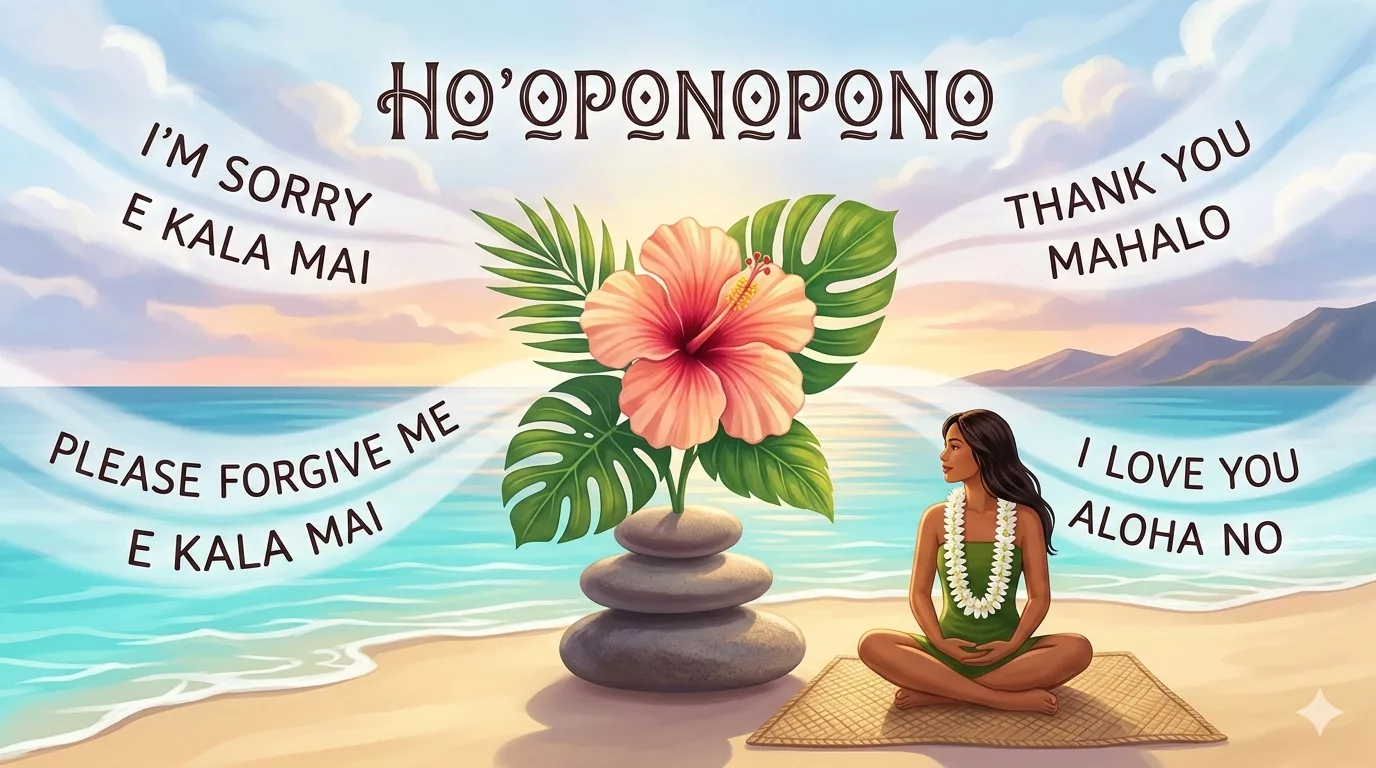
ho’oponopono
Ho’oponopono is an ancient Hawaiian practice for healing, reconciliation, and forgiveness, designed to create inner peace and harmony by releasing toxic memories.
It operates on 100% self-responsibility for one’s reality, utilizing a mantra of four phrases: “I’m sorry” “Please forgive me” “Thank you” “I love you”. [1, 2, 3, 4]
Use the phrases in any order you wish.
Key Aspects of Ho’oponopono Healing:
- The Four Phrases:
- I’m sorry: Acknowledges responsibility for a memory, pain, or problem within your own consciousness.
- Please forgive me: Requests help to forgive oneself for creating or holding onto that pain.
- Thank you: Expresses gratitude for the release and the lessons learned.
- I love you: Transmutes energy, fostering self-love and unity with the divine or universe.
- Core Philosophy: The practice assumes that what occurs in your life is a projection of your own thoughts and memories. By clearing your internal state (cleaning), you change your external reality.
- How to Practice: It is often used as a meditation or mantra, where you repeat the phrases while focusing on a problem, person, or emotional pain.
- Benefits: It is used to mend relationships, heal emotional wounds, reduce stress, and overcome traumatic memories. [2, 4, 5, 6, 7, 8, 9]
This ancient Hawaiian practice can be used for self-forgiveness, as well as for deep healing.
The Ho’oponopono technique gained recognition through Dr. Ihaleakala Hew Len. [7, 9, 10]
Dr. Ihaleakala Hew Len is a Hawaiian psychologist best known for popularizing the modern practice of Ho’oponopono, an ancient Hawaiian method of reconciliation, forgiveness, and healing.
Born in Hawaii, Dr. Hew Len studied psychology and later worked as a clinical psychologist. He became widely known through his association with Morrnah Nalamaku Simeona, a respected Hawaiian healer who adapted traditional Ho’oponopono into a modern self-healing method called Self I-Dentity through Ho’oponopono.
Dr. Hew Len became one of her students and later helped teach and spread the practice internationally.
He gained particular attention for a story from his work at the Hawaii State Hospital, where he reportedly helped improve conditions in a ward for criminally insane patients.
According to accounts often repeated in personal-development circles, he worked on healing himself through Ho’oponopono rather than directly treating the patients, believing that changing his own internal state could influence the environment around him.
Dr. Hew Len later became a teacher and lecturer, sharing the Ho’oponopono practice worldwide through seminars and collaborations with authors such as Joe Vitale, who featured him in the book Zero Limits.
His teaching centers on a simple but powerful idea: personal responsibility for one’s experiences and the healing power of forgiveness, gratitude, and inner cleansing.
The core phrases associated with the modern Ho’oponopono method are:
- I’m sorry.
- Please forgive me.
- Thank you.
- I love you.
Dr. Hew Len is remembered as a spiritual teacher who helped introduce an ancient Hawaiian healing tradition to a global audience interested in mindfulness, forgiveness, and personal transformation.
Common Uses:
- Self-Healing: Clearing negative emotions andself-blame.
- Relationship Healing: Reconciling with others, including distant or broken relationships.
- Trauma Release: Addressingchildhood trauma andanxiety. [4, 5, 7, 8, 10, 11]
[1] https://www.lauraferrerphd.com/insights/hooponopono-meditation-for-healing
[2] https://www.youtube.com/watch?v=4J4C2DQNPK4
[3] https://keolamagazine.com/health/harry-uhane-jim/
[4] https://healingbrave.com/blogs/all/hooponopono-prayer-for-forgiveness
[5] https://medium.com/illumination/how-i-healed-my-childhood-trauma-in-weeks-4432c83ec1b7
[6] https://www.youtube.com/watch?v=h_PlEHCzbMo
[7] https://www.youtube.com/watch?v=-2mM7gz5ZEU
[8] https://www.youtube.com/watch?v=c6Yr3tRgof8
[9] https://www.quora.com/How-effective-is-Hooponopono-for-healing
[11] https://www.compassionatelistening.org/post/power-of-wholeness-and-healing